Friday, September 3, 2021

Ragweed, bindweed

 Got two dye baths going at the moment. Needed to clean up the yard, so I took the opportunity to gather a bunch of ragweed - that innocent looking weed that gives people hay fever. I have no issue with the plant itself, other than it's proliferation and the fact that people blame goldenrod for their hay fever instead of ragweed. Ragweed is wind-pollinated, which is how you breath it in and it causes a histamine reaction. Goldenrod (Solidago spp.) is insect pollinated, which means that the pollen is too heavy for the wind to blow it and the plants rely on insects like bees to pollinate. 

So, while I was out gathering ragweed, I came across some bindweed in one of my garden beds. Mother bucking bindweed. Bindweed gets its common name from the fact that it tightly coils around anything it can - often other plants - and will tightly bind that plant. It's a right pain. Especially since it will often pull a plant down, cut off the plant's ability to get nutrition, and is just a pain.

Bindweed, left, and Ragweed, right

I picked plenty of both plants to do some dyeing. I mordanted 8 oz of wool to do several batches of dyeing. I originally was going to do 2 oz for goldenrod, bindweed, ragweed, and another plant. (Which one, I can't remember at the moment. Probably the avocado that I've got in the freezer, but that's skins and pits...) In the end, I said "what the hell" and through four ounces of wool into each of them. (I should note: It was a random "white wool" with no specific breed or type given, other than it was good for beginning spinners. And now I need to order more of that as it is a nice wool to spin.)


For the ragweed (Ambrosia spp. possibly A. artemisiifolia or common ragweed) I had 1 lb 11.5 oz of plant matter. 
For the bindweed (Convolulus
 spp of some sort) I had 12.1 oz of plant matter.

Essentially, way more plant than I really needed, especially for the ragweed. I probably could have picked more for the bindweed. I tend to follow the 4:1 ratio for fresh plant matter to weight of wool. 

Over the years I've used the following ratio for mordating wool: 
For 4 oz of wool - 1 T alum, 2 t Cream of Tartar

Because I was doing 8 oz of wool, I doubled that amount.

Pot of bindweed, cooking away

For each dye bath, I put the plant matter into a stainless steel pot, filled it with water, and turned the stove on low to med-low. Once I saw steam, I let it go for about an hour, then turned off the burner and let it sit for as long as I could (overnight, if possible). 

So, normally, I let the plant matter cool over night. I didn't do that with the bindweed, because I was in a bit of a time crunch, and would be busy the next three days, so if I didn't do that tonight, it wouldn't get done. I took the plant matter out, and tried to get as much bits out, but in the end, put the wool into a Dollar Store lingerie bag and put that into the dye bath. 

I heated the dye bath to steaming, but not boiling, let it stay there for about an hour, and then shut the heat off and let it cool. 

I'm expecting yellow from both of them, but what type and how deep is going to be the question. 

Wool in ragweed dyebath

So, one thing I learned from this is that I should cover the pot when I'm extracting dye from ragweed. Had quite a headache and dealt with a hell of a stuffy nose. 

Another thing I learned is that it's possible to have too big a pot. If you use your largest pot, you have nothing to pour it into when straining out the dye stuff. Things you learn.

Friday, October 11, 2019

Old Entries - black bean, and more

Dye jobs - black bean
So the black bean dyed wool came out interesting. I knew that I wouldn't get the show stopping blue that others got because I was using regular wool and not the superwash stuff. And I'm fine with that.

Here's the bean soak after an hour:


I soaked the beans for about two days. Soaked the yarn in alum and Cot for about a day. Soaked the yarn in the dye bath for about two days.

And here's the yarn. It's been rinsed with cold water and aired for about an hour so far:

 No flash

 With a flash

It's a grayish bluey purple as my best description. Or, it's a shade off of my bathroom wall. ;)

As for the rest of life, it really does seem like this is a sucky year for a lot of people. At work - one coworker's dad had a stroke, another coworker's daughter (31) had a stroke, my boss is on temporary bedrest in the hospital after she started having contractions at six months into the pregnancy.

So, I'm going to take simply joy in transforming natural wool into a blueish color. Lame, but it's a small thing to be excited over.

---

JUN. 25TH, 2010


Experimenting again

Experimenting again, and this time with black beans. Not food, funny enough. Apparently black beans can be used to create a blue dye. Have the alum. Will get cream of tartar tomorrow (as well as a "use for dying only" set of utensils).

I have two batched of 4 oz of Fisherman's wool. I'm going to try to reuse the dye bath and see if there's any color difference. (And someone who had done this before said 1T+2t of Alum and 2t of CoT per 4 oz/wool.) Have a general game plan. Amazingly enough, I have a general game plan. ;)

It's going to take a few days, but this should be interesting. :D

---

Thursday, October 10, 2019

Old Entries - Dye stuff updated, more

APR. 26TH, 2011

Dye stuff updated - Just pulled the marigold yarn out and rinsed it. It's a very pale yellow, but it's a very clean yellow.

As I had dye bath left over, I quickly added some of my previously dyed black bean yarn. Granted, no prep - so I'm not expecting much. However, if it works, it'll be interesting.

--


Okay, so the marigold dye bath isn't doing much. Probably because I have twice the wool in there that I should. I know that now. And knew it before I put it in, but it was too hard to divide a hank of yarn in to two. Especially wet, steaming ones.


---

More dye stuffThe weather is quite "eh" outside. Just cold enough that even with a sweatshirt, I'm worried about hurting my back (worse). So, after cleaning up from the walnut dye job (finally), I'm looking at the other bucket I have.

Half a pound of marigold leaves soaking.

( Marigold dye bath quandary... )

Okay, so I have over 8 qts of marigold juice. What fit into the crock pot outside is on "high" right now. I'm hoping that some of it will boil down, and if that happens, I'll add the rest. I have about half a pound of wool in warming water on the stove. 1 Tb alum and 1 tsp CoT, and about 2.5 gallons of water. (I would have done more water, but... I'm using the biggest pot I have.)

About 45 minutes from now, we'll have a look and see if both things are ready to go.

---

APR. 25TH, 2011

Need to go get the wool and weigh it, but thought I'd jot some notes down first.

Next time, more water. I probably could have filled the bucket and let the whole thing soak. Some of the water seems to have evaporated, but all in all, more water next time.

I didn't realize just how much this would stink. It reminds me of an uncleaned horse stall. More walnut hulls next time. I'll see if I can talk to Katriina about letting me collect more upon more.

I let the hulls go black. Next time, I want to try starting the bath when they are green and see what happens.

8-quart crock - good idea.

The dye stuff has been heating for about three hours. Gave up boiling it, but since it's been steaming for an hour, I added the yarn. (soaked in warm water, and gentle squeezed to remove water.)

Going to let it sit for about an hour. I probably could have dyed more yarn in this pot, but didn't have any plain cotton (stuff that I knew was 100% cotton), nor did I have any linen that I wanted to sacrifice. However, this means I can set some of this aside afterwards and try other things.

--

Used about 4 oz. of Fisherman's wool to a full 8qt. pot of dye bath. No mordant. Result: A nice wood brown. (No other real way I can explain it. Yes, it's brown, but it's lacking a lot of yellow that most browns tend to have. Okay, it's a bit darker than walnut shells.) Had it steaming for about 90 minutes before I added the wool, which I had soaked in warm water. Added the wool and kept it at temperature for about another 90 minutes. Rinsed until no further dye came out and left to dry outside. (Then brought in the next morning as it was still WET. Granted, I didn't realize that it was going to drizzle all night long.)

I also had a small amount of roving. I had turned the dye bath off, but it was still quite warm. Turned it on low and added the roving. As there was a lot less of it, I let it go for about 40 minutes, before I removed it. The brown is lighter, closer to a dark tan. Rinsed and placed outside. As the place I put it outside was more sheltered than the wool, the roving was dry in the morning. (And the focus of several birds. I may have lost some of the roving to nest builders.)

No mordant on either.

The walnut hulls were still giving off color, so I added more water to the bucket they are in. A lot more water than I originally had added to the first batch. However, this will give me a chance to compare (somewhat) and see how the walnuts hold up.

And holy smokes! Do I still have a lot of dyebath. I'm going to put wool in there cold and see if it affects the color.

Old entries from another journal - Irish flowers

Going through a different platform, and realized I had some things there. So, I'm combining them and bringing them here.

JUN. 4TH, 2011
Dye project - Iris flowers

So, some interesting stuff with Iris flowers.
I love them. They are GORGEOUS. However, I'm mad at them as I want that color on that wool.
Which, in order to do that I need tin crystals, according to one book I have. (Wish the older, 1950's book had mentioned that.) However, I didn't know that, so I treated it a bit like the red cabbage, but first time through I strained the flowers out. I think the heat denatured the proteins, or, as Marie suggested, they oxidized, but it didn't do much to the wool (apprx. 4 oz alum + cot). Added more flowers to the dye bath and wool, and put the temp on. It did seem to transfer some of the purple to the wool, but that washed out on rinsing. (DRAT!) However the wool has a greenish-olive tint to the khaki color.
I'm going to try one more thing, and then be done with the flowers. The roots and leaves, however... mine, all mine. I have a large clump in my garage waiting for me to come clean them, sort good from bad, and experiment. I still have one clump that's blooming, as well as the Siberian ones that will probably do better elsewhere.

Ah, my refuge. :D Now, if only I didn't have to mow the lawn, I'd be happier. Anyone have a goat or sheep they can loan?

Saturday, June 15, 2019

Portland, at a quick glance


Portland ewe with lambs.
Photo from sheep101.info
 Portland Sheep
--

from opendomesday.org


PLACE: PORTLAND
Hundred: Cullifordtree
County: Dorset
Total population: 96 households (very large).
Households: 1 villager. 90 smallholders. 5 slaves.
Ploughland: 3 lord's plough teams. 23 men's plough teams.
Other resources: Meadow 8 acres. Pasture 8 * 8 furlongs.
Livestock in 1086: 3 cobs. 14 cattle. 27 pigs. 900 sheep.
Lord in 1066: King Edward.
Lord in 1086: King William.
Tenant-in-chief in 1086: King William.
Phillimore reference: 1,1


Livestock in 1086: 3 cobs. 14 cattle. 27 pigs. 900 sheep.


Portland rams.
Image from sheep101.info
"To find a living example of the Celtic type that came to Britain by the southern route, we have to go to another island, at the opposite end of the country. Here a breed whose lineage reached back into the Iron Age survived into the least century. It's forebears once grazed across the heaths and downs of south-west England in a great family of tan-faced, horned sheep...Long after this type disappeared from the mainland it survived on the Isle of Portland, living  on spare pasture, and was renowned for its sweet, delicate mutton, rich  cheese and fine wool."  (Counting Sheep, pps. 11-12)


"Best known for. Being a historic breed with a mild-tasting meat that was favored by British royalty, and a fleece that is interesting to work with." -F&FSB, pg 229 of ebook


Portland is believed to have been in Britain before the Romans came, and survived much of the "improvements" that were done during the Industrial Revolution due to several factors: being some of the only type of sheep that were able to survive on the Isle of Portland, and being isolated in a bit of land that became an island when the waters got too high. From sheep101.info, "It is most likely that the Portland is all that is left of the Western Tanfaced horn, common in the Southwest during the Middle Ages."


Early in the 20th century, the breed was greatly reduced, and no longer found on the Isle of Portland. At Calke Abbey in Derbyshire, a flock had been established in 1770, and pockets of flocks survived elsewhere. While no numbers were given, writings seem to indicate that, like the Manx, this was a breed on the brink of extinction. Recently, the sheep were reintroduced back to the Isle of Portland.With the RBST reporting that ewes are usually around 35-40kg (78-100 lbs) and rams are around 55kg (approx 120 lbs), the sheep themselves are small. Both sexes have horns, with the males having larger, gracefully curling horns. They are easy lambers, with multiples being rare - but they are able to breed "out of season". They are also thrifty eaters, being able to eat scrub and shrubs that more delicate sheep are unable to. Apparently, they are good for conservation work.


The fleece is an interesting one, and given the size of the sheep it's from, it's no surprize that the fleece is on the small side as well, coming in about 2-3kg (4.5-6.5 lbs). The micron count (taken from Fleece and Fiber Sourcebook), is 26-31 microns (SC: 50s-60s); which classifies the fleece in the medium/coarse category. The staple length of the fiber is about 6.5-10 cm (2.5-4") (again, F&FSB). The fleece often has small reddish tan hairs in it, from the face and legs, and is creamy in color.  While "coarse", it's not unpleasant. A few things I don't know just yet is how what is available modernly is different from what was available in pre-1700's. If I had to take a guess, I would say not much since a flock was established at an abbey in the 1770's, so there is some continuity in the breed. 


--


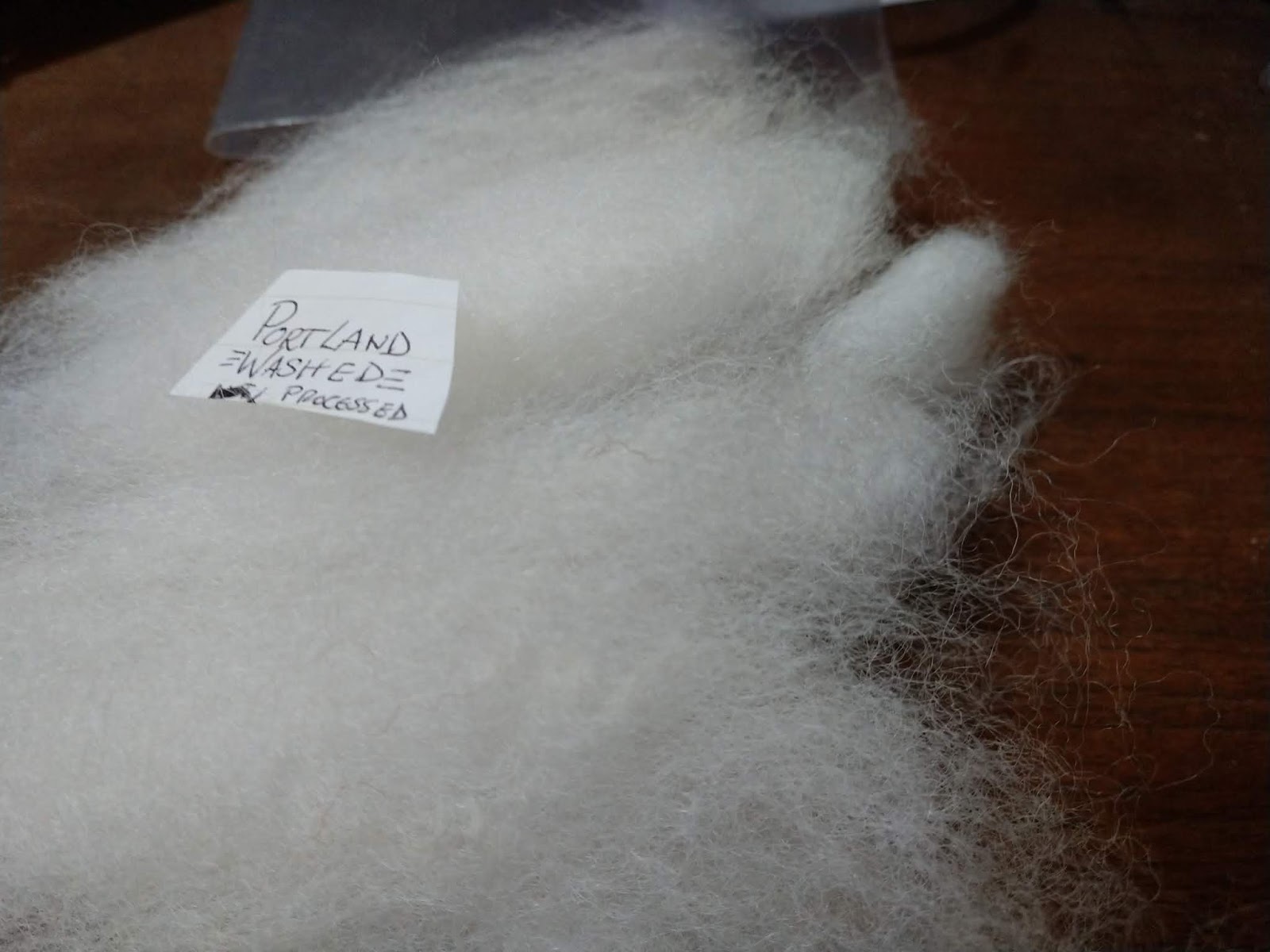
The fleece I used was purchased raw from a seller in England. Light skirting was done before putting it in the post, to help with cost of postage. When I received it, I did open  it up and skirt it. Next, I rebagged it into smaller quantities to wash it, and scoured it. Several washings with Ivory dish soap, and Dreft laundry detergent. While there's been a lot of speculation about how scouring would have been done in period, I choose the modern method as the best to remove dirt and lanolin and to prevent an interest from insects (DIEDIEDIE).

 After scouring, I air dried the wool. Then, I went about processing it, starting with minicombs that are double rowed. These are similar to images from illuminated manuscripts, with the difference that they are smaller. (And less pointy, which means I'm less likely to take a chunk of flesh out accidentally.)

After several passes through with the combs, the combed fleece is set aside in a bag, and another batch is started. 

For spinning, I used combed fleece, and didn't run it through the drum carder. I spun it using a drop spindle, a bottom weight drop spindle, and plied it to make a 2-ply yarn. 
The spindle is a homemade one, weighing less than an ounce total. 

--
Work Cited
Bridge, Terry. Rare Breeds: Unusual Farm Animals from Around the World. New York: Chartwell     Books, Inc.; 2010.

Dowling, Robert and Lawrence Alderson.  Rare Breeds: Endangered Farm Animals in Photographs. Boston: Little, Brown and Company; 1994. First North American Edition.

Robson, Deborah and Carol Ekarius. The Fleece & Fiber Sourcebook : More Than 200 Fibers from Animal to Spun Yarn. North Adams, Mass.: Storey Pub.; 2011.

Trow-Smith, Robert. English Husbandry: From the Earliest Times to the Present Day. London: Faber and Faber Ltd.; 1951.

Walling, Philip. Counting Sheep: A Celebration of the Pastoral Heritage of Britain. London: Profile Books, LTD.; 2014.

Also:
www.rbst.org.uk
sheep101.info


Saturday, May 25, 2019

Bobbin Lace revision

So, I screwed up. Since I wasn't able to present my revision of my bobbin lace research. I'm going to do one more revision, compiling all my updates into one, more cohesive document.

That's going to come in the next few weeks. I also have to take out some images, because of copyright. So, stay tuned (if anyone watches).

Wednesday, August 9, 2017

This is the pits!

So, onto the avocado pits!

A lot of the pits were freezer burned/freezer dried? Well, in the freezer for a long time.

I ended up with about 24 ounces of pits, that were chopped in half, and then chopped into at least 1/8ths after that (more if the pits were bigger, less if the pits were smaller.)

One thing I learned from the peels was that the 3:1 ratio was probably too much wool (12 ounces peel to 4 ounces wool). I think I would have gotten a better color with a 4:1 or even a 6:1 ratio.

So, I upped the dye stuff to wool ratio for the pits. I've read that this should produce a rosie beige. We'll see.

I'm not mordanting the wool for this, as there are (according to the internets), enough tannins in the pits to dye without mordants. I figured why not give it a try and see what happens.

Chopped pits are in the pot, with ample water. They were on medium heat, and have been turned down to low. Going to let them simmer for probably an hour and then cool slightly before straining and adding the wetted wool.

Part of me wants to just add the wool to the pits, but there's a lot of small, saw dust like stuff from chopping up the (very dried) pits. I think the color will be better if there's contact between the dye stuff and the wool, but there's also larger chance of the dye stuff getting mixed up in the wool, meaning more time combing. (But I have to do that anyway, so I'm tempted to just say screw it and throw the wool into the dye pot with the dye stuff.)

Avocados!

So, I've been collecting avocado peels and pits from friends for ages. I'd love to say how long, but I honestly can't remember.

The Dear Husband has been hinting that he'd like some of the freezer back from avocados (as well as yarn), so I got around to taking a few bags out.

A lot of the peels had been in the freezer for a while. Some of the pits were rock hard from freezer burn. And I scraped a lot of remaining avocado from the skins. (Note to self - wash the peels before putting them in the freezer. That helps with the ones I've done, but not the ones I've gotten from other people.)

So, with the peels, I scraped what avocado I could off the peels, and chopped/tore them up into nickel to quarter sized pieces.  I ended up with about about 12.5 ounces of avocado peel, and used about 4 ounces of wool (cheviot, mostly, but might have some other breeds in there.)
Wool was mordanted with normal amount of alum and cot (2T alum/1.5 Cream of Tarter)

The dye was strained using an old cotton bedsheet, because of all the avocado bits that were loosened. The bedsheet was chosen over cheesecloth because of the tighter weave. The avocado bits were really small, and the worry was that it would manage to get through the cheese cloth.

After straining, I resoaked the peels adding 1.5 c of baking soda added to dye pot after a while. The extract did become deeper. I added a cup of baking soda to the wool and in process dyeing.

After about 45 minutes, I strained the second extract into the dye pot with the wool.

Tuesday, September 27, 2016

Pokeberries, 2016

One of these years, I need to get all my pictures off my camera and onto these blog posts... Alas, another thing on the To Do list.

So, last year I used this as the basis for dyeing with pokeberries:

https://osbornfiber.com/2010/09/27/dyeing-with-pokeberries/

And decided to give it a try again. However, there is one thing I hadn't counted on. I shouldn't take the pokeberries out of the freezer until I'm ready to use them. I meant to dye with them about a week ago (or was it two?). So, the berries have been in my fridge for at least a week. Not the end of the world, but the berries were not as firm as they were last year. In fact, they were... squicky. I have no better way to describe them.

I decided to soldier on, because - pokeberries! -and just figured I'd deal with things like not knowing the weight of just the berries, because I did them in small batches. And by that I mean that squished and squeeze the stems/berries in the bag first, and then I removed the berries from the stem in small batches, and the removed berries went into a strainer sitting in the pot I thought I was going to use. (Last year, I used a crock pot. My concern with my crock pot is that it hasn't been giving consistent results - sometimes it gives great results, other times it doesn't seem to get hot enough for long enough.) I think I'm just going to add the dye to the cooled mordant bath as the pot is bigger.

So, this year I'm using the stove. (Sorry, love!) It's rather colorful after the past few weeks of walnuts, annatto, and exhaust baths. I'm trying to get the kitchen cleared out, which is why I have someone coming over tomorrow and want to get this done today.

Per the Osborn Fibers post, I am currently mordanting the wool (about 4 oz give or take of corridale/cormo cross) in a 50/50 mix of water and distilled vinegar. It was simmering for about an hour, so now I'm going to let it cool. Normally, I'd mix things together in one pot, or pour the dye stuff into the warm mordant bath, but pokeberry dye is rather heat sensitive, so I'm letting it cool down. I'm hoping to get one bath in before I need to get going for the evening.

Hopefully, in the next few days I'll get this done and remember to get pictures taken.

Wednesday, September 21, 2016

Fall dyeing, day one - walnut and annatto

I've been playing with dyes again, starting with walnut and annatto.

For the walnut bath, I mordanted the 4 ounces ish of fiber (Peredale, washed, but not processed). The walnut juice/extract (you'll hear me use both terms, but basically, soaked some black walnuts that I collected while helping out friends out at Bristol Ren Fair in Bristol, WI.) I let them turn brown/black.

I did a first boil/soak, strained, and gave that to a friend for walnut ink (for more on that, I suggest looking up Ian the Green's blog. He had a lot on different inks, and a few posts on walnut ink.)

After that, I put the walnuts in a 5gal orange bucket, added water, and let them sit for a while. Like, a few weeks. When I wanted to dye with extract, I just strained some, refilled the liquid in the bucket, and went to the stove.

The wool came out a nice light brown. Nothing too exciting, but I figured I'd have some fun and overdye it with some old annatto I had found while cleaning out the kitchen. Three handfuls of annatto seeds, with some baking soda, bring to temp, let sit, and they let cool.

I did that and added it to the walnut bath. And then I did it again, with the remainder of the annatto I had. I didn't measure anything, but added about 1 cup of baking soda. Heated, let simmer for about 20-30 mins, and strained. Added to the walnut bye bath, and brought the walnut bath to a simmer again.

The color I was hoping for was... I don't even know. But what I ended up with was very autumnal. A golden auburny orange sort of color.  Part of me thinks "rusty 70's orange" but my husband thought it was cool (the auburny description was from him) . I think I'll like it more when it's blended with something. Maybe like a robin's breast red, or even a yellow, green or brown. We'll see what I come up with.

Tuesday, August 2, 2016

Queen Anne's Lace 2016, take 1

My yard is full of Queen Anne's Lace (QAL), once again.

Went out today, and harvested QAL. As I did, I cut it up into 2-3":  roots, stems, and flowers. I didn't weigh them, but filled a Halloween plastic cauldron full of the chopped bits. Before I harvested the QAL I put water into a 6 qt crock pot - about a gallon's worth. When the plastic cauldron was mostly full, I went and put as much into the crock pot as I could do, which was most of the cauldron, but not all.

I've been having concerns about my crock pot getting things hot enough, so I let the QAL in the crock pot stew for several hours before adding more water.

I did some testing of my tap water, and figured it to be about 8ish. Not an exact measure, but it does give me more of an idea of what I'm starting at with the water.

The last time I did this, dipping a small skeing in ammonia and it turned it darker, so I'm going to add some baking soda to see if I can get more of a shift in color.

Now, to mordant wool after dinner arrives.

Things that I keep looking up

So, I keep looking up very mundane things over and over, so, I'm going to write them down:

Vinegar is a acid.
Ammonia is a base.
Baking soda is also a base.

For four ounces of wool this is the formula if I plan on using an alum/cream of tartar mordant:

4 oz of wool, mordanted with 2 T alum and 1.5 t of Cream of Tartar, simmered for about 35-40 minutes

...And the new kitten has escaped and fell into the wool washing tubs...

Friday, January 1, 2016

SO that's why I should record these things

So, with a lot going on, I'm trying to remember something I did before. It was some yarn that was spun and loaned to me to dye.

And in trying to recreate a color I did, I have no idea what I did.

And with that in mind, I'm going to be better about recording what I've done. (Especially since I've used some left over dye stuff and have no idea what it was, other than in my fridge for a very long time. Probably used for that project I mentioned above.)

Right now, I'm trying to remember if it was logwood or cochineal I used to dye.

I have been dying. Pokeweed, Queen Anne's Lace, and more. I've just been horrible at recording what I did, so now I have to do it over again, and make the same mistakes as well.

Not my favorite way to spend my time, but it's my own fault.

So, learn from me. Write things down.

No, you probably won't remember what you did...

Friday, June 20, 2014

Has it been that long?

Hadn't meant to spend so much time away from dyeing, but I've learned to spin and love it. I've spent much of the past two years spinning, scouring, and processing fleeces.

However, I do want to get back to dyeing. So tonight, I'm about to mordant some wool and try out some sumac or annatto tomorrow.  I seem to be reading that people have better luck with annatto after they let it soak, which is something I was unaware of the first time I tried dyeing with it.

So, I'll do an overnight soak on the annatto seeds, and then try again.

Right now, I have 6.3 oz of Jacob wool mordanting in 3 T of alum with 2.25 t of COT. I was going to try something else with this wool, so I had it soaking in water overnight. I took it out this morning and wrapped it in a towel to keep it damp. Seemed a pity to dry it only to need to wet it again later...

Since I have 6.3 oz of wool, I've read that I should use half the wool weight of annatto. That's nice, as I don't think I bought that much. (woohoo...)

Tonight, I'll let the annatto soak, and possible Saturday, I'll dye. I'll try tomorrow, but don't know if it will work, time wise.

(I dyed, naturally? I dyed of natural causes? Yeah, I'll work on it.)

I also have 17ish oz of dorset to dye next. Right now, I'm giving it a quick wash (well, not so quick...) as there was still a bit of lanolin feel to it, which can effect how/if the dye attached to the yarn. We think that happened previously, so I'm about to go give it a rinse and think about mordanting it. Since we've done greens, blues, and browns, my friend asked for reds, yellows, and oranges this time around. We'll see what I can do. :) I'm thinking of doing 2/3rds of a skein with yarrow, and then going from the other end and dyeing 2/3rds in madder. I also plan on doing one of the skeins with annatto seeds, and another one with sumac. We'll see how these turn out! :)


Monday, August 20, 2012

Birch bark

Okay, I didn't weight the birch bark before I soaked it. It's been soaking outside for the better part of the summer, which mean a good amount of it has evaporated. Especially because it was one of the driest summers on record. However, it has rained recently, which has added some of the water back.

Going to mordant four ounces of wool, but will probably only use two ounces for the dye.

Time to see what happens.

Thursday, January 12, 2012

Hand spun wool, Tumeric, walnut

Haven't dyed anything in a while, but 12th Night is coming up this weekend, and I have some handspun wool that someone loaned me to dye. What a better present than actually giving it back, dyed?

The wool was given to Gypsy a while ago (it was someone's first attempt at sheering a sheep), and it sat in her garage for a while. Two summers ago, she pulled it out and we spent the better part of a day sorting and washing the wool. (Getting rid of the "too icky" or the "too coarse" or the "not useable" stuff, and then we put some fleece in nylon bags, and then put them into some soapy, almost hot water. Minor, very minor agitation. Drain, do again with a little less soap about two more times, until we used just hot water for the final bath/rise. Dried flat.)

Gypsy then proceeded to spin the wool to the weight she desired.

Last hank was then made into a hat. (Black eyed sue yarn) It's very cool to see a hat and know I had a part in it's creation. Not just making it, but the taking of raw material to useable, to a different color than it started. It's very cool to me. :)

She mentioned what type of sheep it was (began was a D I believe).

This hank is a little over 4 oz, but I think I'll stick with the 2T alum and a light 1.5t C.o.T.

I'm going to do that and then figure out the rest. (Like how I'm going to strain the walnut stuff which is outside, where it's really freaking cold.)

--


Wool is mordanting. Time to figure out what I'm going to do.

Friday, August 5, 2011

Brown Eyes Susan

Okay, I haven't fully ID'ed the plant that I just dyed with. The common name is either black-eyed susans, or brown-eyed Susan, depending on which parent I'm talking to.  It's also right among some struggling purple coneflowers, and I don't remember if I planted yellow coneflowers there or not.  Regardless, it's either a Rudbeckia or and Echinacea, and we'll leave it at that for now.

I gathered the flowers way late at night, and gathered about 8 oz of flower heads. Plopped them into the trusty crock pot, poured water over it and let it go for about two hours on high.  I premordanted two mini skeins - one just about 2 oz, and one just a bit over 2 oz, so I was able to use my trusty formula of 2T alum to 1.5 tsp Cream of Tartar. I accidentally added more alum than I planned as I ran out of one jar and then found a second one, adding the stuff from the first jar and then about 1.5 T from the second. Techincally, I believe I added more than 2T. Such is life. The yarn doesn't seem worse the wear for it.


I added the wool to the simmering flowerheads, put the lid on and kept it on high for about 90 minutes. Went out, turned the crock pot off, and let everything sit.

Now, I was going into this expecting another yellows. Yellows seem to be a very common result.

I wasn't expecting a green, grey, browny color. I also expected the color to wash out, as has been my luck sometimes when getting a non-yellow color. No more than usual.

To further experiment, I took the second skein (unrinsed) and poured vinegar over half, and ammonia over the other half. The vinegar didn't do much, other than turn the vinegar purple. The ammonia greened up the yarn. Much more of a green-yellow, with very little of the grey cast.

An interesting experiment that I may have to do again.

Monday, August 1, 2011

Queen Anne's Lace

Okay, so I have a lot of Queen Anne's Lace growing in my yard. Last year, it embarrassed me; this year, it intrigued me.

I had read conflicting things about what part to use, so I went and cut about 9oz (maybe a little more) of flowers, with a tiny bit of stem. (Sepals attached as well.) To that I added tap water, and have been letting them sit for a while in the crock pot.  I have a three-ish oz hank of wool and a one-ish oz hank in the water, mordanting with 2T alum and 1.5 tsp C.o.T.

According to The Fold in Marengo, I should have finely chopped up the plant or put it in a blender. Instead I'm just going to leave it in the hot water for a while and see if that will extract enough color. Many of the sources said a 2:1 ratio of plant material to dry weight of goods. So, hopefully, I've done this correctly.

Why, one might ask, did I do a large skein and a smaller skein? I wanted to experiment with over dipping the dyed wool in amonia, so I thought a smaller skein would be nice to see the contrast. Both skeins are going through the mordanting and dye bath, so the colors should be relatively the same before the after-bath.

--

Update:

I had the yarn in the hot dye bath for several hours, before turning it off and letting it sit overnight.  The color is a nice, bright, lemony butter yellow.  I rinsed the larger skeing, and the ammonia'd the smaller skein. Wasn't expecting anything too dramatic, but it did give it more of an orange tint, closer to tumeric in color.

Next year, I want to try an iron after bath. Rumor has it, that would give me more of a grey-green.

Monday, June 27, 2011

Curly Dock

So, I've had curly dock (Rumex crispus) growing in my garden.  Been meaning to pull it for a while, but then decided to check and see if it's something people have used to dye with. And the answer is yes, apparently they have.

Curly dock seems to be native to Eurasia and, according to illinoiswildflowers.info, was first observed in the US in the 18th century. Apparently, the young leaves can be eaten and are reportedly rich in vits C and A. (I make note of this for my friends who like to know such things. They like to know that for when the zombies attack or the world ends.)

I'm going to try to do two baths - one with the leaves, the other with the roots. If I'm ambitious enough, I may even try a dye bath using the inflorescence. 

After having a look through the books, Wild Color said equal weight dye material and yarn for dock, regardless of if leaf or root. I'm going to stick with my normal 4 oz of wool that'll be mordanted with alum and CoT.

The leaves I gathered weighted about 6 oz.   While I'm mordanting the wool, I'll go rinse off the roots and set them aside.  Natural Color by Ira G. mentioned that the root color will still be good if the root dries, so that will be less of a concern. 

Off to mordant some wool.

So far:

6oz of curly dock leaves were put into a crock pot with about 1 gal of filtered water. Set to "high".


Thursday, June 9, 2011

Iris Root

Apparently, I'm very forgetful as of late.

I did this on June 9th, added in on 6/27:

Iris Root dye bath.

4 oz fisherman's wool
approx 12 oz iris germanica root (several days out of ground, spend overnight in a bucket of water, and then hacked up)

Wool was alumed and cot'ed. (2T, and 1.5tsp., respectively)

Roots were dug up, put in wheel barrow sort of contraption and left there until I could deal with them. Put then in a bucket, ran water over them, left them to sit for a few hours (had to have dinner and sit). Went out and removed leaves, soft spots, and chopped them up to about dice sized pieces (ish). Put in crock put, poured a little water over, swished around, drained dirty water. Put in more clean water, put crock pot on high and went inside.

Came back out every hour for about three hours to check, finally turned it off and went back inside, leaving the crock pot and dye bath juice to sit.

Prior to the dye bath being made: Soaked wool, added it to mordant bath, heated it for about two hours (was doing yard work that day), let it sit to cool. After... a day, I think, I rinsed the wool, and took it out to the dye bath.

Added it, heated it. It did actually reach a boiling. Turned it off and let it sit.

It's been that way since Tuesday. Instead of the grey-blue I was told to expect, I've gotten a yellow. Not quite what I was expecting, but maybe if I had dried the roots, it would have turned out differently. Plan on trying that again, as I have more irises that I need to dig up.