Friday, October 11, 2019

Old Entries - black bean, and more

Dye jobs - black bean
So the black bean dyed wool came out interesting. I knew that I wouldn't get the show stopping blue that others got because I was using regular wool and not the superwash stuff. And I'm fine with that.

Here's the bean soak after an hour:


I soaked the beans for about two days. Soaked the yarn in alum and Cot for about a day. Soaked the yarn in the dye bath for about two days.

And here's the yarn. It's been rinsed with cold water and aired for about an hour so far:

 No flash

 With a flash

It's a grayish bluey purple as my best description. Or, it's a shade off of my bathroom wall. ;)

As for the rest of life, it really does seem like this is a sucky year for a lot of people. At work - one coworker's dad had a stroke, another coworker's daughter (31) had a stroke, my boss is on temporary bedrest in the hospital after she started having contractions at six months into the pregnancy.

So, I'm going to take simply joy in transforming natural wool into a blueish color. Lame, but it's a small thing to be excited over.

---

JUN. 25TH, 2010


Experimenting again

Experimenting again, and this time with black beans. Not food, funny enough. Apparently black beans can be used to create a blue dye. Have the alum. Will get cream of tartar tomorrow (as well as a "use for dying only" set of utensils).

I have two batched of 4 oz of Fisherman's wool. I'm going to try to reuse the dye bath and see if there's any color difference. (And someone who had done this before said 1T+2t of Alum and 2t of CoT per 4 oz/wool.) Have a general game plan. Amazingly enough, I have a general game plan. ;)

It's going to take a few days, but this should be interesting. :D

---

Thursday, October 10, 2019

Old Entries - Dye stuff updated, more

APR. 26TH, 2011

Dye stuff updated - Just pulled the marigold yarn out and rinsed it. It's a very pale yellow, but it's a very clean yellow.

As I had dye bath left over, I quickly added some of my previously dyed black bean yarn. Granted, no prep - so I'm not expecting much. However, if it works, it'll be interesting.

--


Okay, so the marigold dye bath isn't doing much. Probably because I have twice the wool in there that I should. I know that now. And knew it before I put it in, but it was too hard to divide a hank of yarn in to two. Especially wet, steaming ones.


---

More dye stuffThe weather is quite "eh" outside. Just cold enough that even with a sweatshirt, I'm worried about hurting my back (worse). So, after cleaning up from the walnut dye job (finally), I'm looking at the other bucket I have.

Half a pound of marigold leaves soaking.

( Marigold dye bath quandary... )

Okay, so I have over 8 qts of marigold juice. What fit into the crock pot outside is on "high" right now. I'm hoping that some of it will boil down, and if that happens, I'll add the rest. I have about half a pound of wool in warming water on the stove. 1 Tb alum and 1 tsp CoT, and about 2.5 gallons of water. (I would have done more water, but... I'm using the biggest pot I have.)

About 45 minutes from now, we'll have a look and see if both things are ready to go.

---

APR. 25TH, 2011

Need to go get the wool and weigh it, but thought I'd jot some notes down first.

Next time, more water. I probably could have filled the bucket and let the whole thing soak. Some of the water seems to have evaporated, but all in all, more water next time.

I didn't realize just how much this would stink. It reminds me of an uncleaned horse stall. More walnut hulls next time. I'll see if I can talk to Katriina about letting me collect more upon more.

I let the hulls go black. Next time, I want to try starting the bath when they are green and see what happens.

8-quart crock - good idea.

The dye stuff has been heating for about three hours. Gave up boiling it, but since it's been steaming for an hour, I added the yarn. (soaked in warm water, and gentle squeezed to remove water.)

Going to let it sit for about an hour. I probably could have dyed more yarn in this pot, but didn't have any plain cotton (stuff that I knew was 100% cotton), nor did I have any linen that I wanted to sacrifice. However, this means I can set some of this aside afterwards and try other things.

--

Used about 4 oz. of Fisherman's wool to a full 8qt. pot of dye bath. No mordant. Result: A nice wood brown. (No other real way I can explain it. Yes, it's brown, but it's lacking a lot of yellow that most browns tend to have. Okay, it's a bit darker than walnut shells.) Had it steaming for about 90 minutes before I added the wool, which I had soaked in warm water. Added the wool and kept it at temperature for about another 90 minutes. Rinsed until no further dye came out and left to dry outside. (Then brought in the next morning as it was still WET. Granted, I didn't realize that it was going to drizzle all night long.)

I also had a small amount of roving. I had turned the dye bath off, but it was still quite warm. Turned it on low and added the roving. As there was a lot less of it, I let it go for about 40 minutes, before I removed it. The brown is lighter, closer to a dark tan. Rinsed and placed outside. As the place I put it outside was more sheltered than the wool, the roving was dry in the morning. (And the focus of several birds. I may have lost some of the roving to nest builders.)

No mordant on either.

The walnut hulls were still giving off color, so I added more water to the bucket they are in. A lot more water than I originally had added to the first batch. However, this will give me a chance to compare (somewhat) and see how the walnuts hold up.

And holy smokes! Do I still have a lot of dyebath. I'm going to put wool in there cold and see if it affects the color.

Old entries from another journal - Irish flowers

Going through a different platform, and realized I had some things there. So, I'm combining them and bringing them here.

JUN. 4TH, 2011
Dye project - Iris flowers

So, some interesting stuff with Iris flowers.
I love them. They are GORGEOUS. However, I'm mad at them as I want that color on that wool.
Which, in order to do that I need tin crystals, according to one book I have. (Wish the older, 1950's book had mentioned that.) However, I didn't know that, so I treated it a bit like the red cabbage, but first time through I strained the flowers out. I think the heat denatured the proteins, or, as Marie suggested, they oxidized, but it didn't do much to the wool (apprx. 4 oz alum + cot). Added more flowers to the dye bath and wool, and put the temp on. It did seem to transfer some of the purple to the wool, but that washed out on rinsing. (DRAT!) However the wool has a greenish-olive tint to the khaki color.
I'm going to try one more thing, and then be done with the flowers. The roots and leaves, however... mine, all mine. I have a large clump in my garage waiting for me to come clean them, sort good from bad, and experiment. I still have one clump that's blooming, as well as the Siberian ones that will probably do better elsewhere.

Ah, my refuge. :D Now, if only I didn't have to mow the lawn, I'd be happier. Anyone have a goat or sheep they can loan?

Saturday, June 15, 2019

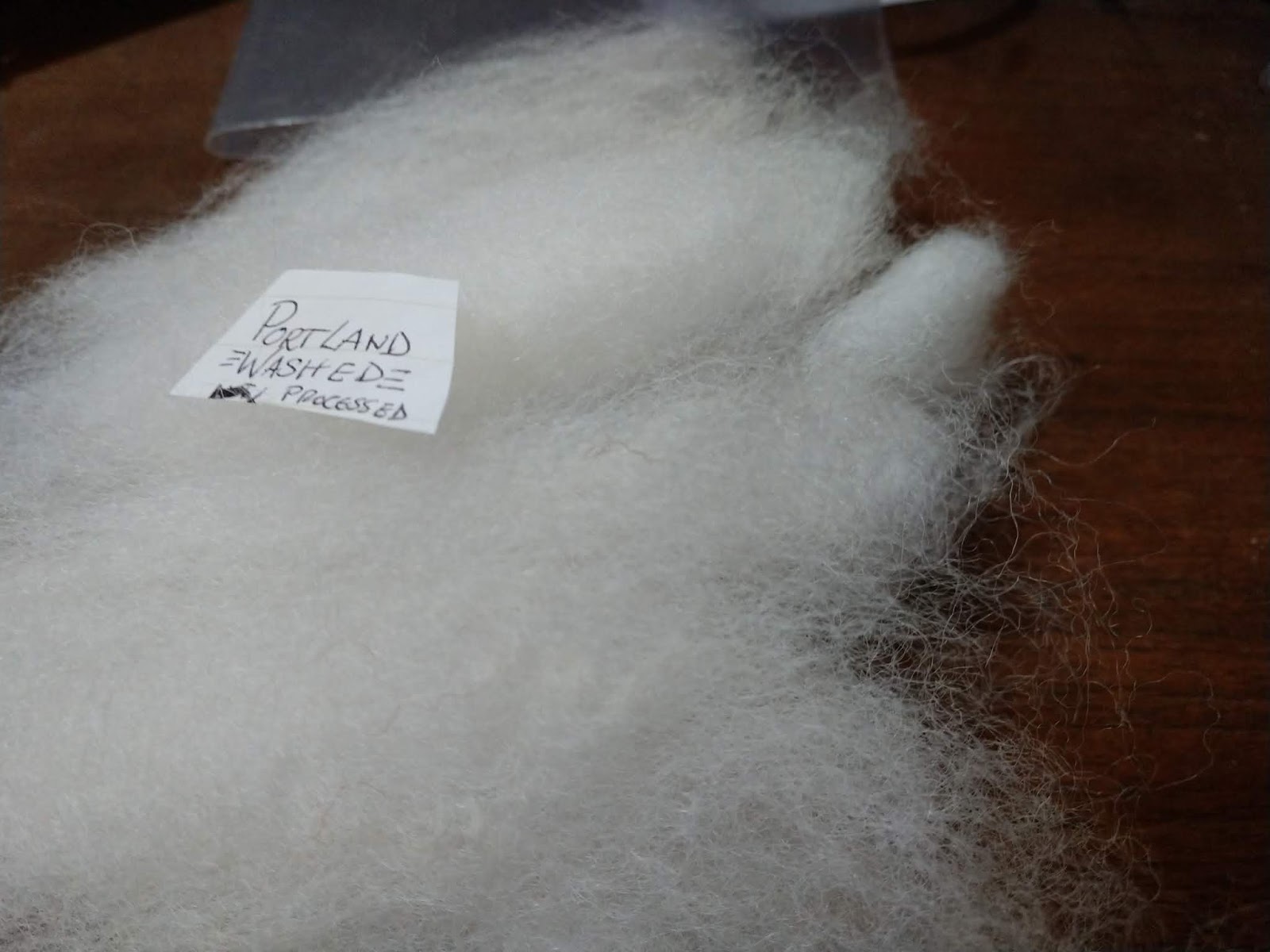
Portland, at a quick glance


Portland ewe with lambs.
Photo from sheep101.info
 Portland Sheep
--

from opendomesday.org


PLACE: PORTLAND
Hundred: Cullifordtree
County: Dorset
Total population: 96 households (very large).
Households: 1 villager. 90 smallholders. 5 slaves.
Ploughland: 3 lord's plough teams. 23 men's plough teams.
Other resources: Meadow 8 acres. Pasture 8 * 8 furlongs.
Livestock in 1086: 3 cobs. 14 cattle. 27 pigs. 900 sheep.
Lord in 1066: King Edward.
Lord in 1086: King William.
Tenant-in-chief in 1086: King William.
Phillimore reference: 1,1


Livestock in 1086: 3 cobs. 14 cattle. 27 pigs. 900 sheep.


Portland rams.
Image from sheep101.info
"To find a living example of the Celtic type that came to Britain by the southern route, we have to go to another island, at the opposite end of the country. Here a breed whose lineage reached back into the Iron Age survived into the least century. It's forebears once grazed across the heaths and downs of south-west England in a great family of tan-faced, horned sheep...Long after this type disappeared from the mainland it survived on the Isle of Portland, living  on spare pasture, and was renowned for its sweet, delicate mutton, rich  cheese and fine wool."  (Counting Sheep, pps. 11-12)


"Best known for. Being a historic breed with a mild-tasting meat that was favored by British royalty, and a fleece that is interesting to work with." -F&FSB, pg 229 of ebook


Portland is believed to have been in Britain before the Romans came, and survived much of the "improvements" that were done during the Industrial Revolution due to several factors: being some of the only type of sheep that were able to survive on the Isle of Portland, and being isolated in a bit of land that became an island when the waters got too high. From sheep101.info, "It is most likely that the Portland is all that is left of the Western Tanfaced horn, common in the Southwest during the Middle Ages."


Early in the 20th century, the breed was greatly reduced, and no longer found on the Isle of Portland. At Calke Abbey in Derbyshire, a flock had been established in 1770, and pockets of flocks survived elsewhere. While no numbers were given, writings seem to indicate that, like the Manx, this was a breed on the brink of extinction. Recently, the sheep were reintroduced back to the Isle of Portland.With the RBST reporting that ewes are usually around 35-40kg (78-100 lbs) and rams are around 55kg (approx 120 lbs), the sheep themselves are small. Both sexes have horns, with the males having larger, gracefully curling horns. They are easy lambers, with multiples being rare - but they are able to breed "out of season". They are also thrifty eaters, being able to eat scrub and shrubs that more delicate sheep are unable to. Apparently, they are good for conservation work.


The fleece is an interesting one, and given the size of the sheep it's from, it's no surprize that the fleece is on the small side as well, coming in about 2-3kg (4.5-6.5 lbs). The micron count (taken from Fleece and Fiber Sourcebook), is 26-31 microns (SC: 50s-60s); which classifies the fleece in the medium/coarse category. The staple length of the fiber is about 6.5-10 cm (2.5-4") (again, F&FSB). The fleece often has small reddish tan hairs in it, from the face and legs, and is creamy in color.  While "coarse", it's not unpleasant. A few things I don't know just yet is how what is available modernly is different from what was available in pre-1700's. If I had to take a guess, I would say not much since a flock was established at an abbey in the 1770's, so there is some continuity in the breed. 


--


The fleece I used was purchased raw from a seller in England. Light skirting was done before putting it in the post, to help with cost of postage. When I received it, I did open  it up and skirt it. Next, I rebagged it into smaller quantities to wash it, and scoured it. Several washings with Ivory dish soap, and Dreft laundry detergent. While there's been a lot of speculation about how scouring would have been done in period, I choose the modern method as the best to remove dirt and lanolin and to prevent an interest from insects (DIEDIEDIE).

 After scouring, I air dried the wool. Then, I went about processing it, starting with minicombs that are double rowed. These are similar to images from illuminated manuscripts, with the difference that they are smaller. (And less pointy, which means I'm less likely to take a chunk of flesh out accidentally.)

After several passes through with the combs, the combed fleece is set aside in a bag, and another batch is started. 

For spinning, I used combed fleece, and didn't run it through the drum carder. I spun it using a drop spindle, a bottom weight drop spindle, and plied it to make a 2-ply yarn. 
The spindle is a homemade one, weighing less than an ounce total. 

--
Work Cited
Bridge, Terry. Rare Breeds: Unusual Farm Animals from Around the World. New York: Chartwell     Books, Inc.; 2010.

Dowling, Robert and Lawrence Alderson.  Rare Breeds: Endangered Farm Animals in Photographs. Boston: Little, Brown and Company; 1994. First North American Edition.

Robson, Deborah and Carol Ekarius. The Fleece & Fiber Sourcebook : More Than 200 Fibers from Animal to Spun Yarn. North Adams, Mass.: Storey Pub.; 2011.

Trow-Smith, Robert. English Husbandry: From the Earliest Times to the Present Day. London: Faber and Faber Ltd.; 1951.

Walling, Philip. Counting Sheep: A Celebration of the Pastoral Heritage of Britain. London: Profile Books, LTD.; 2014.

Also:
www.rbst.org.uk
sheep101.info


Saturday, May 25, 2019

Bobbin Lace revision

So, I screwed up. Since I wasn't able to present my revision of my bobbin lace research. I'm going to do one more revision, compiling all my updates into one, more cohesive document.

That's going to come in the next few weeks. I also have to take out some images, because of copyright. So, stay tuned (if anyone watches).

Wednesday, August 9, 2017

This is the pits!

So, onto the avocado pits!

A lot of the pits were freezer burned/freezer dried? Well, in the freezer for a long time.

I ended up with about 24 ounces of pits, that were chopped in half, and then chopped into at least 1/8ths after that (more if the pits were bigger, less if the pits were smaller.)

One thing I learned from the peels was that the 3:1 ratio was probably too much wool (12 ounces peel to 4 ounces wool). I think I would have gotten a better color with a 4:1 or even a 6:1 ratio.

So, I upped the dye stuff to wool ratio for the pits. I've read that this should produce a rosie beige. We'll see.

I'm not mordanting the wool for this, as there are (according to the internets), enough tannins in the pits to dye without mordants. I figured why not give it a try and see what happens.

Chopped pits are in the pot, with ample water. They were on medium heat, and have been turned down to low. Going to let them simmer for probably an hour and then cool slightly before straining and adding the wetted wool.

Part of me wants to just add the wool to the pits, but there's a lot of small, saw dust like stuff from chopping up the (very dried) pits. I think the color will be better if there's contact between the dye stuff and the wool, but there's also larger chance of the dye stuff getting mixed up in the wool, meaning more time combing. (But I have to do that anyway, so I'm tempted to just say screw it and throw the wool into the dye pot with the dye stuff.)

Avocados!

So, I've been collecting avocado peels and pits from friends for ages. I'd love to say how long, but I honestly can't remember.

The Dear Husband has been hinting that he'd like some of the freezer back from avocados (as well as yarn), so I got around to taking a few bags out.

A lot of the peels had been in the freezer for a while. Some of the pits were rock hard from freezer burn. And I scraped a lot of remaining avocado from the skins. (Note to self - wash the peels before putting them in the freezer. That helps with the ones I've done, but not the ones I've gotten from other people.)

So, with the peels, I scraped what avocado I could off the peels, and chopped/tore them up into nickel to quarter sized pieces.  I ended up with about about 12.5 ounces of avocado peel, and used about 4 ounces of wool (cheviot, mostly, but might have some other breeds in there.)
Wool was mordanted with normal amount of alum and cot (2T alum/1.5 Cream of Tarter)

The dye was strained using an old cotton bedsheet, because of all the avocado bits that were loosened. The bedsheet was chosen over cheesecloth because of the tighter weave. The avocado bits were really small, and the worry was that it would manage to get through the cheese cloth.

After straining, I resoaked the peels adding 1.5 c of baking soda added to dye pot after a while. The extract did become deeper. I added a cup of baking soda to the wool and in process dyeing.

After about 45 minutes, I strained the second extract into the dye pot with the wool.