 |
| Portland ewe with lambs. Photo from sheep101.info |
--
from opendomesday.org
PLACE: PORTLAND
Hundred: Cullifordtree
County: Dorset
Total population: 96 households (very large).
Households: 1 villager. 90 smallholders. 5 slaves.
Ploughland: 3 lord's plough teams. 23 men's plough teams.
Other resources: Meadow 8 acres. Pasture 8 * 8 furlongs.
Livestock in 1086: 3 cobs. 14 cattle. 27 pigs. 900 sheep.
Lord in 1066: King Edward.
Lord in 1086: King William.
Tenant-in-chief in 1086: King William.
Phillimore reference: 1,1
Livestock in 1086: 3 cobs. 14 cattle. 27 pigs. 900 sheep.
 |
| Portland rams. Image from sheep101.info |
"To find a living example of the Celtic type that came to Britain by the southern route, we have to go to another island, at the opposite end of the country. Here a breed whose lineage reached back into the Iron Age survived into the least century. It's forebears once grazed across the heaths and downs of south-west England in a great family of tan-faced, horned sheep...Long after this type disappeared from the mainland it survived on the Isle of Portland, living on spare pasture, and was renowned for its sweet, delicate mutton, rich cheese and fine wool." (Counting Sheep, pps. 11-12)
"Best known for. Being a historic breed with a mild-tasting meat that was favored by British royalty, and a fleece that is interesting to work with." -F&FSB, pg 229 of ebook
Portland is believed to have been in Britain before the Romans came, and survived much of the "improvements" that were done during the Industrial Revolution due to several factors: being some of the only type of sheep that were able to survive on the Isle of Portland, and being isolated in a bit of land that became an island when the waters got too high. From sheep101.info, "It is most likely that the Portland is all that is left of the Western Tanfaced horn, common in the Southwest during the Middle Ages."
Early in the 20th century, the breed was greatly reduced, and no longer found on the Isle of Portland. At Calke Abbey in Derbyshire, a flock had been established in 1770, and pockets of flocks survived elsewhere. While no numbers were given, writings seem to indicate that, like the Manx, this was a breed on the brink of extinction. Recently, the sheep were reintroduced back to the Isle of Portland.With the RBST reporting that ewes are usually around 35-40kg (78-100 lbs) and rams are around 55kg (approx 120 lbs), the sheep themselves are small. Both sexes have horns, with the males having larger, gracefully curling horns. They are easy lambers, with multiples being rare - but they are able to breed "out of season". They are also thrifty eaters, being able to eat scrub and shrubs that more delicate sheep are unable to. Apparently, they are good for conservation work.
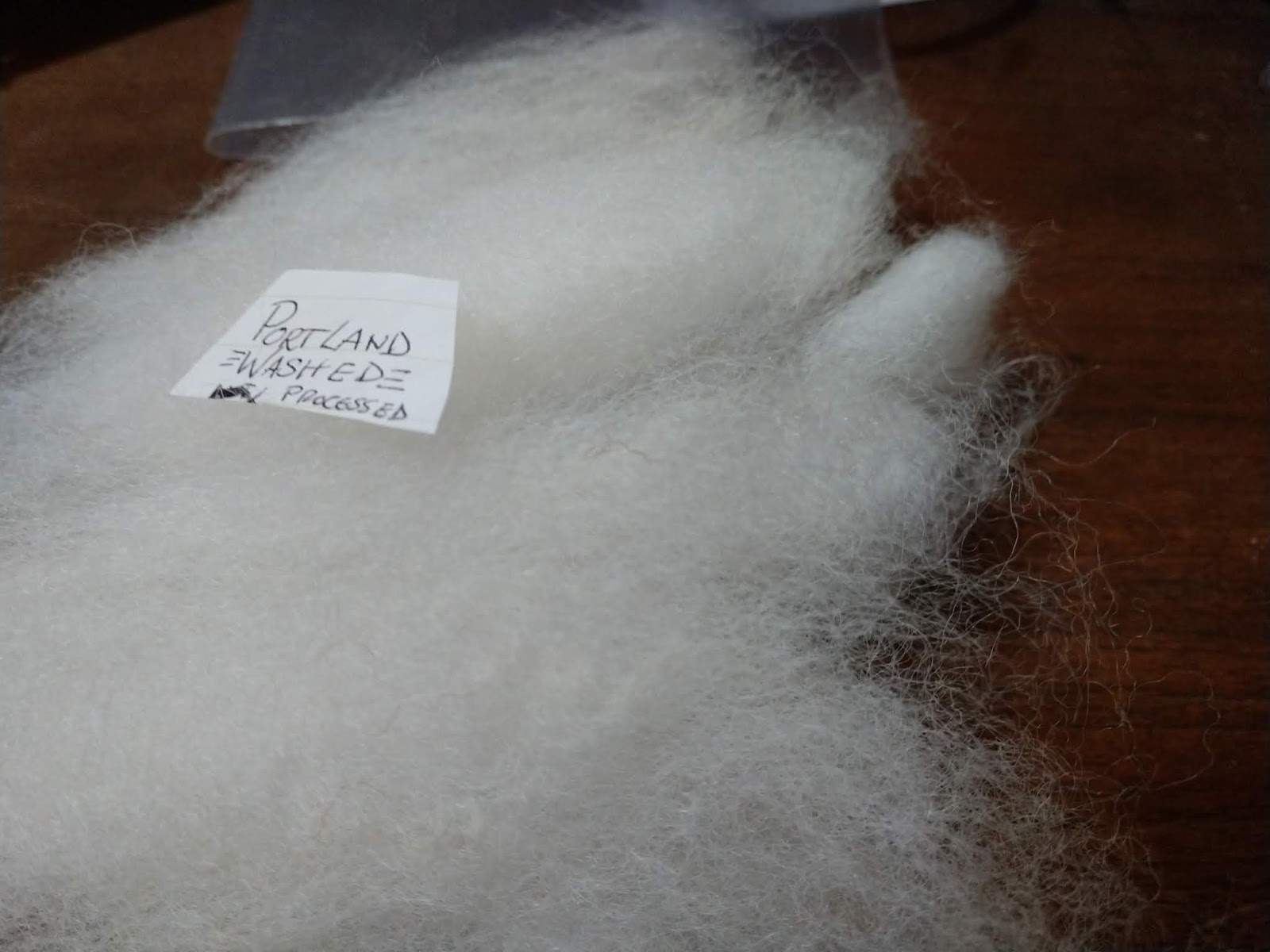
The fleece is an interesting one, and given the size of the sheep it's from, it's no surprize that the fleece is on the small side as well, coming in about 2-3kg (4.5-6.5 lbs). The micron count (taken from Fleece and Fiber Sourcebook), is 26-31 microns (SC: 50s-60s); which classifies the fleece in the medium/coarse category. The staple length of the fiber is about 6.5-10 cm (2.5-4") (again, F&FSB). The fleece often has small reddish tan hairs in it, from the face and legs, and is creamy in color. While "coarse", it's not unpleasant. A few things I don't know just yet is how what is available modernly is different from what was available in pre-1700's. If I had to take a guess, I would say not much since a flock was established at an abbey in the 1770's, so there is some continuity in the breed.

--
The fleece I used was purchased raw from a
seller in England. Light skirting was done before putting it in the post, to
help with cost of postage. When I received it, I did open it up and skirt
it. Next, I rebagged it into smaller quantities to wash it, and scoured it.
Several washings with Ivory dish soap, and Dreft laundry detergent. While
there's been a lot of speculation about how scouring would have been done in
period, I choose the modern method as the best to remove dirt and lanolin and
to prevent an interest from insects (DIEDIEDIE).
After scouring, I air dried the wool. Then, I went about processing it, starting with minicombs that are double rowed. These are similar to images from illuminated manuscripts, with the difference that they are smaller. (And less pointy, which means I'm less likely to take a chunk of flesh out accidentally.)
After scouring, I air dried the wool. Then, I went about processing it, starting with minicombs that are double rowed. These are similar to images from illuminated manuscripts, with the difference that they are smaller. (And less pointy, which means I'm less likely to take a chunk of flesh out accidentally.)
After several passes through with the combs, the combed fleece is set aside in a bag, and another batch is started.
For spinning, I used combed fleece,
and didn't run it through the drum carder. I spun it using a drop
spindle, a bottom weight drop spindle, and plied it to make a 2-ply
yarn.
The spindle is a homemade one, weighing
less than an ounce total.
--
Work Cited
Bridge, Terry. Rare Breeds: Unusual Farm Animals from
Around the World. New York: Chartwell Books, Inc.; 2010.
Dowling, Robert and Lawrence
Alderson. Rare Breeds: Endangered Farm Animals in Photographs.
Boston: Little, Brown and Company; 1994. First North American Edition.
Robson, Deborah and Carol
Ekarius. The Fleece & Fiber Sourcebook : More Than 200 Fibers
from Animal to Spun Yarn. North Adams, Mass.: Storey Pub.; 2011.
Trow-Smith, Robert. English Husbandry: From the Earliest Times to the Present Day. London: Faber and Faber Ltd.; 1951.
Walling, Philip. Counting Sheep: A Celebration of the Pastoral Heritage of Britain. London: Profile Books, LTD.; 2014.
Also:
www.rbst.org.uk
sheep101.info
